Construction and remodeling
Drills, impact drivers, circular saws, oscillating tools and jobsite vacuums keep framing, finish work and cleanup on one charging routine.
Industry pillars
Different teams ask the same cordless platform to do different jobs. A framing crew wants cutting speed and impact fastening. A repair shop wants lights, inflators and sockets close at hand. A property team wants outdoor runtime without fuel handling. Ryobi industry planning starts with the task pattern, then works backward to tool families, batteries, accessories and service support.
Applications
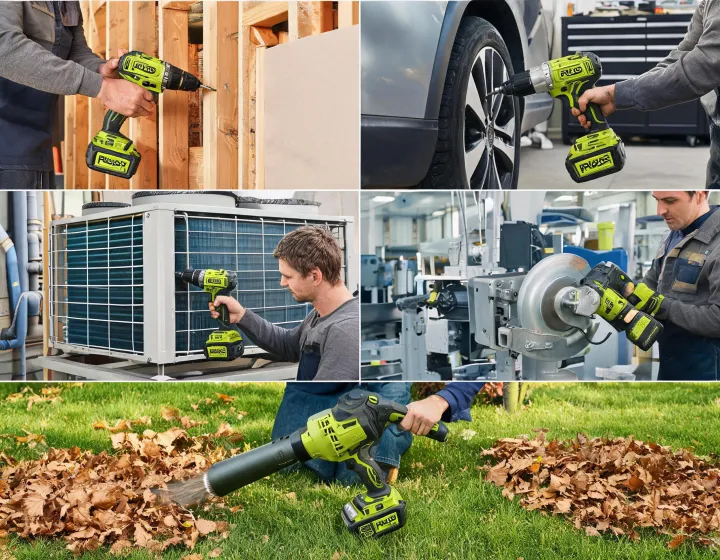
Drills, impact drivers, circular saws, oscillating tools and jobsite vacuums keep framing, finish work and cleanup on one charging routine.
Impact wrenches, ratchets, inflators, lights and storage make sense when they are staged by bay, mobile van or weekend repair bench.
Mechanical rooms reward compact drills, lights, pipe-cutting accessories, valve work tools and a clear kit for service calls.
Portable maintenance teams need predictable batteries, fastener compatibility, cutting tools and tool carts that move with the repair.
Mowers, chainsaws, blowers, hedge trimmers and pressure washers shift the planning focus from torque to runtime, noise and storage.
Transformation cases
A remodeling team separated compact packs for drill-driver work from higher-output packs for saws. The change reduced tool swapping confusion and made charger placement part of the morning setup.
A grounds group paired mower and blower runtime with backup packs at the maintenance room, then kept hand tools and fasteners in a separate cart for quick fixture repairs.
An automotive bay grouped impact, inflator, light and socket storage together so technicians could handle tire, trim and under-hood tasks without borrowing from another station.
Describe the crew, the tool tasks and the runtime expectation. We can help shape a practical kit around the industry instead of a generic catalog list.